

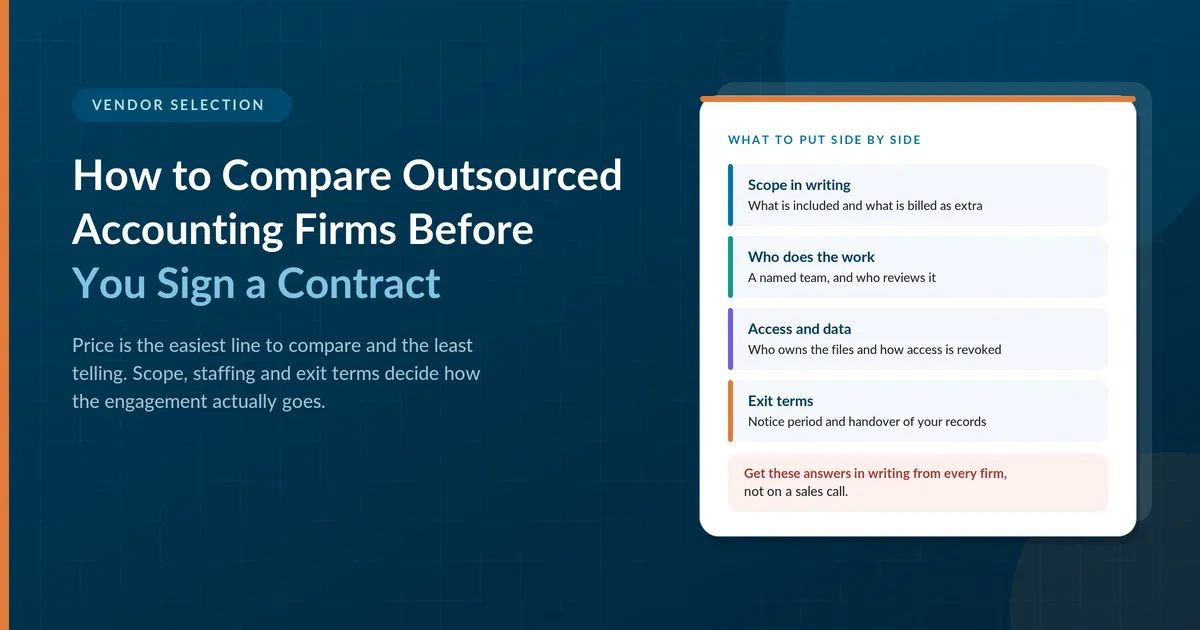
Most outsourced accounting firms look alike in the first call. Each one promises accurate books, timely reports, and a dedicated team. The websites use similar language, and the proposals follow similar templates.
The differences show up later, in the third month, when a report arrives late or a question goes unanswered. By then you have signed a contract and moved your records. This guide helps you find those differences before you commit, using a scorecard, a short list of red flags, and the contract terms worth checking line by line.
Start With What You Need, Not What They Offer
Before you speak to any provider, write down what you want the firm to do. Providers will otherwise define the scope for you, and their definition will fit their process, not your business.
List the following:
- The tasks you want to hand off, such as bookkeeping, payroll, month-end close, or tax coordination.
- The reports you need and how often.
- Your software, including who will own the file.
- Your industry’s special needs, such as job costing, inventory, or multi-state sales tax.
- Any deadlines, such as a lender report or a tax filing.
This list becomes your comparison sheet. Every firm answers the same questions, so you compare like with like.
Build a Simple Scorecard
A scorecard keeps the decision away from charm and toward evidence. Weight each criterion by how much it matters to you, then score each firm from 1 to 5.
Here is a sample weighting:
| Criterion | Weight |
|---|---|
| Scope and deliverables | 25% |
| Industry experience | 20% |
| Process and close schedule | 20% |
| Security and controls | 20% |
| Contract terms and exit | 15% |
Now suppose two firms score as follows. Firm A earns 4, 5, 3, 4, and 3. Firm B earns 5, 3, 4, 3, and 5.
Firm A: (0.25 × 4) + (0.20 × 5) + (0.20 × 3) + (0.20 × 4) + (0.15 × 3) = 3.85.
Firm B: (0.25 × 5) + (0.20 × 3) + (0.20 × 4) + (0.20 × 3) + (0.15 × 5) = 4.00.
The gap is small, which is the point. Price is deliberately left out of the score. Use it as a tiebreaker once you know which firms meet your needs. A cheap firm that scores 3.0 is not a bargain.
What to Look for in Outsourced Accounting Firms
Each criterion deserves a specific test. Here is what a strong answer looks like.
Scope and deliverables. The firm should name each task, each report, and each delivery date. Vague phrases like “full-service support” are a warning. Many accounting firms for small business use generic menus, so ask them to put your exact tasks in writing.
Industry experience. Ask how many clients they serve in your industry and what they do differently for them. A firm that works with contractors should talk about retainage and job costing. One that serves ecommerce sellers should talk about payout reconciliation and sales tax by state.
Process and close schedule. Ask for the monthly timeline. When do you send documents? When does the firm close the books? When do reports arrive? A firm that cannot name a date does not have a routine.
Security and controls. You are handing over bank access and tax data, so ask how it is protected. The IRS publishes data-security guidance for tax professionals in Publication 4557. A capable firm can explain its own practices in plain terms, including access controls, data encryption, and what happens when a team member leaves.
Contract terms and exit. Covered in detail below.
Questions That Separate Strong Firms From Average Ones
Use these in every first call. The quality of the answer matters more than the answer itself.
- Who will actually work on my account, and what are their credentials?
- How many clients does each person handle?
- What is your process when a transaction is unclear or a receipt is missing?
- Can I see a sample monthly report with customer details removed?
- How do you review work before it reaches me?
- Who covers when my main contact is out?
- Does anyone outside your firm, such as a subcontractor, touch my data?
Question 2 deserves attention. A firm that assigns too many clients to each person will struggle to hold deadlines, no matter how good the people are.
Contract Terms to Read Line by Line
A contract is where promises become obligations. Check these points before you sign.
- Scope. The tasks, reports, and delivery dates should appear in writing, not just in a proposal deck.
- Fees. Know what is covered and what costs extra, such as cleanup, catch-up work, or extra entities. Ask how and when fees can change.
- Term and renewal. Watch for automatic renewals and long lock-in periods. A 90-day pilot or a month-to-month option reduces risk.
- Data ownership. Your books belong to you. The contract should say so, and it should explain how you get your files back.
- Access. You should keep the master login to your bank and software accounts.
- Termination. Look for notice periods and any exit fees. Ask what a handoff to the next provider looks like.
- Liability. Check what the firm is responsible for if an error causes a penalty or a loss.
- Confidentiality and subcontracting. The agreement should limit who can see your data.
If a firm resists putting any of these in writing, treat that as information.
Red Flags to Watch For
Some warning signs show up early:
- A price quoted before anyone has looked at your books.
- Pressure to sign quickly or a discount that expires this week.
- No named team or contact.
- No sample reports or examples of past work.
- Reluctance to give you access or ownership of your records.
- Promises of outcomes no provider can guarantee, such as a specific tax savings figure.
None of these proves a firm is poor. Together, they suggest that you should look elsewhere.
Check References and Run a Pilot
A reference call takes 15 minutes and tells you more than any proposal. Ask for two clients with a similar size and industry. Ask them how reports arrive, how the firm handles mistakes, and whether they would sign again.
Then reduce your risk with a pilot. A 90-day start with clear deliverables lets you test the process before a long commitment. If you want a baseline for what a full engagement covers, this explainer on what outsourced accounting is lays out the standard services.
How to Make the Final Call
- Score each firm on the same criteria and weights.
- Remove any firm that fails a must-have, such as security or data ownership.
- Check references for the top two.
- Compare price only among the firms that remain.
- Start with a pilot, and set review dates at 30, 60, and 90 days.
Final Thought
The best outsourced accounting firms are not the ones with the longest service lists. They are the ones that can show you their process, name your team, put commitments in writing, and make it easy to leave if the fit is wrong. A careful comparison takes a few hours. Fixing a poor choice takes months, so the effort pays for itself.
This article is for general information only and is not tax or legal advice. Consult a qualified professional about your situation.
About the author: Vandana Mehta, CA, CPA (USA), is a compliance and financial reporting specialist at Datastub, an outsourced accounting and bookkeeping firm serving U.S. contractors, ecommerce sellers, and growing small businesses. Crunch. Strategize. Deliver.